Wawel Dragon - did it really exist?
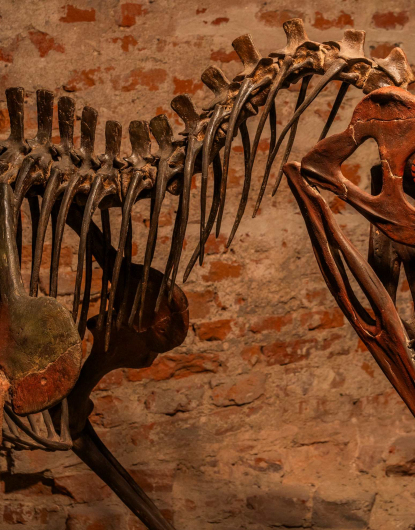
Long before the legend of the monster living in the Dragon’s Den took root at the foot of Wawel Hill, a real predator roamed the lands of what is now southern Poland. It lived over 210 million years ago, at the end of the Triassic period, in a world that was nothing like the one we know today.
At a brickworks near the village of Lisowice in Silesia, palaeontologists – Prof. Tomasz Sulej and Dr Grzegorz Niedźwiedzki discovered numerous fossils of a reptile, which they dubbed the Wawel Dragon.
The prehistoric predator
This reptile, measuring around 6 metres in length and living some 210 million years ago, was a distant cousin of crocodiles and birds – a rather exotic connection, we dare say. Its name refers to the Wawel Dragon. In this way, the list of palaeontological discoveries commemorates the legendary monster that made Dragon’s Den its lair.
The dragon was a bipedal reptile. Its body shape was somewhat reminiscent of a crocodile, though it also had features typically associated with dinosaurs. Its bones make up a mosaic of anatomical features – some of which we know from early dinosaurs, whilst others are found in the Triassic relatives of modern crocodiles.
A message from the distant past
The discovery in Lisowice comprised not just bones, but also fossilised three-toed paw prints and coprolites - fossilised droppings. Although it may sound surprising, these kinds of discoveries enable us to take a closer look into the everyday life of a prehistoric predator, discover how it moved, what other animals it hunted and what kind of environment it lived in. It is a record of life from millions of years ago, preserved in stone like a message from the distant past.
The bipedal reptile from Lisowice frequently shed its teeth, which is why individual teeth were also found scattered within the rock. They had distinctive serrated edges, which helped them tear the flesh of their prey apart.
A dragon skeleton at the Wawel Castle
The reconstructed skeleton and a genuine tooth of the prehistoric predator – the real Wawel Dragon – can be seen at the Wawel Castle as part of the ‘In Search of the Dragon’ trail. The exhibits have been loaned from the Museum of Evolution at the Institute of Palaeobiology of the Polish Academy of Sciences and will be on display from 15 April to 15 September 2026.
This is where legend meets science!