
The Keep and the Danish Tower
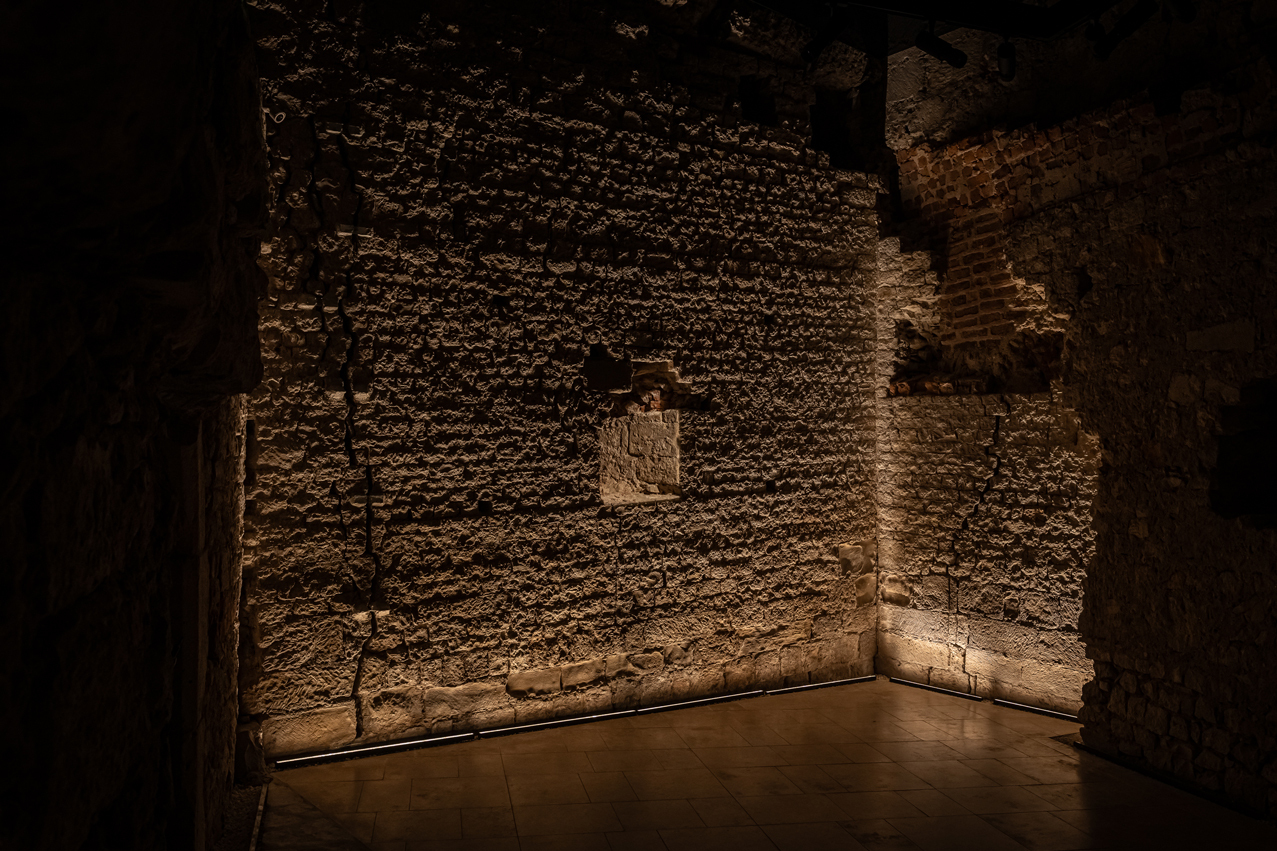
The oldest traces of the defensive architecture of the Wawel Castle
The Keep - the detached defensive tower - was one of the most important parts of castles in the Middle Ages. It was characterised by thick walls and a rather impressive height, and it was usually built on a circular, square or polygonal plan.
Sightseeing
Visitors will be able to explore the underground areas of the Danish Tower (The Keep) exclusively as part of guided tours in Polish, in groups of up to 20 people.
For individual visitors, guided tours will take place on Sundays at 3 p.m. – as part of The Armoury tour (in Polish).
For individual visitors, guided tours will take place on Sundays at 3 p.m. – as part of The Armoury tour (in Polish).
The Romanesque Keep of the Wawel Castle

The oldest structure of its kind was built on the Wawel Castle in the first half of the 12th century on the north-eastern side of the hill. Its remains were discovered during the survey carried out by Zygmunt Hendel and Adolf Szyszko-Bohusz in 1906-1918.
The remaining part, which can be seen today in the Hall Under the Birds, allows us to determine that the keep was at least 18 metres tall and its walls, which were built on a rectangular plan reminiscent of a square, were characterised by the thickness of around 1,5 metres, or 5 feet. The structure was built out of limestone, filled in with sandstone. It was erected using the opus emplectum technique, where each side of a wall is constructed with finished stone blocks, leaving a substantial void between them, which is then filled with a mixture of broken stones mixed with mortar.
The largest preserved fragment of the keep can be seen in the second hall of the preserve. The deep crack, which can be seen on the structure, likely dates back to the time when the keep was still in use. The structural issues could have led to its demolition or a sudden collapse.
The Gothic Danish Tower

In the 14th century, the Romanesque keep was replaced with a new building - the Danish Tower. Its name is a reference to the visit of Eric, King of Denmark, who lived there during his visit to the Wawel Castle for the coronation of Queen Sophia in 1424.
The early Gothic tower had several rooms located on the site of the upper terrace of the contemporary Royal Gardens. The remains were discovered during an archaeological survey in 2003 and the parts of the existing walls comprise the preserve.
The tower was built of the stones recovered after the demolition of the Romanesque keep - they can be seen in the preserve. The Gothic façade, which was partially preserved to this day, was restored in parts during the works carried out by Szyszko-Bohusz in 1922-1924. The survey carried out in 1995-1996 allowed to discern the original walls from the restorations.
Renaissance overhauls and later changes
The construction of the Renaissance palace in the early 16th century meant that the existing medieval structures were included in the eastern wing of the castle. The brick vault ceiling in one of the halls was likely added at that time. At the top, one can see a small opening, which could have been used as a dump or as a transport fixture.
The conditions inside the building, in particular the stable and low temperature ensured by the thick walls, were conductive to its use as a warehouse - the role similar to that of the neighbouring cellars in the eastern wing.
The preserve also features numerous traces of later structural interventions, the final ones carried out in the 20th century.
The conditions inside the building, in particular the stable and low temperature ensured by the thick walls, were conductive to its use as a warehouse - the role similar to that of the neighbouring cellars in the eastern wing.
The preserve also features numerous traces of later structural interventions, the final ones carried out in the 20th century.