
All the Faces of the Queen - an Intervention
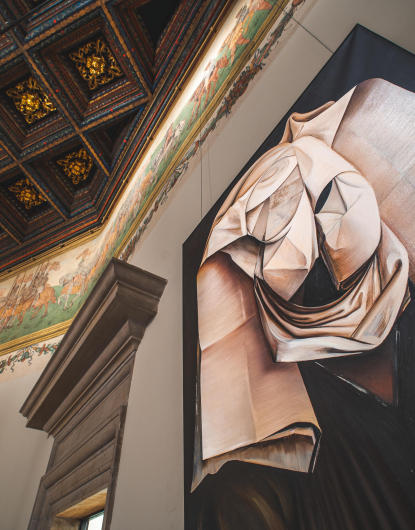
A painting by Ewa Juszkiewicz at Wawel
Ewa Juszkiewicz’s painting Untitled / after Rogier van der Weyden (2012) is a temporary contemporary art intervention within the Castle walls. It has replaced the portrait of Anne Jagiellon, which has been moved to the first floor for the duration of the Anna Jagiellon. All the Faces of the Queen temporary exhibition. The visitors are reminded of this by the photograph next to it.

The exhibition’s subtitle - All the Faces of the Queen - refers to the multitude of her depictions and the various roles she played in her life. She was the daughter of King Sigismund the Old and Queen Bona Sforza, the sister of the last Jagiellonian monarchs, Grand Duchess of Lithuania, queen and ruler.
A temporary exhibition dedicated to Anne Jagiellon presents her through various depictions and contexts. Ewa Juszkiewicz’s intervention expands this narrative to include a contemporary reflection on the very process of creating the image of a historical figure.
The Secret of the Hidden Face

Painting: Ewa Juszkiewicz, Untitled / after Rogier van der Weyden, 2012, oil on canvas, 140 × 90 cm, Art Collection of the Bielsko BWA Gallery
The starting point for Juszkiewicz’s painting is Rogier van der Weyden’s Woman in a White Veil (c. 1440, Gemäldegalerie, Staatliche Museen zu Berlin). The artist reconstructs a historical depiction, preserving its composition, costume, precision of detail and the subtle rendering of light and the texture of the fabrics, altering the most important element of the painting – the woman’s face is concealed by a draped piece of fabric.
Covering faces is a distinctive feature of Ewa Juszkiewicz’s paintings, as the artist draws on historical depictions of women and reworks them in her creations, replacing faces by objects of symbolic significance, headdresses, as well as plant and animal forms. As a result, these well-known paintings retain their original structure whilst taking on new meanings. The face is the most important feature, which enables the viewer to recognise the depicted person. In Juszkiewicz’s work, it is secondary to form, which carries various meanings and symbols.
Covering faces is a distinctive feature of Ewa Juszkiewicz’s paintings, as the artist draws on historical depictions of women and reworks them in her creations, replacing faces by objects of symbolic significance, headdresses, as well as plant and animal forms. As a result, these well-known paintings retain their original structure whilst taking on new meanings. The face is the most important feature, which enables the viewer to recognise the depicted person. In Juszkiewicz’s work, it is secondary to form, which carries various meanings and symbols.
Old Paintings, New Meanings
Ewa Juszkiewicz is primarily interested in the way in which paintings shape our perceptions of women depicted throughout the history of art. Many elements influence how a character is perceived - their face, clothing, posture, gestures, the way they are portrayed, and any accompanying props. Changing any of these elements may alter the entire interpretation of the work. This contemporary reinterpretation of a historical painting draws attention to how we construct and interpret depictions of historical figures, and how such images influence our perception of the protagonists. What is more, placing the piece in the space previously reserved for the portrait of Anne Jagiellon lends this artistic gesture an additional dimension.
Born in 1984, Ewa Juszkiewicz belongs to the group of contemporary Polish painters exploring the theme of historical depictions of women. Her works stem from the dialogue with the canon of art history and on the transformation of existing images. Untitled / after Rogier van der Weyden also raises the question of how a historical painting becomes a starting point for reflection on the ways in which women are depicted and how their depictions are made.
Dr Bogumiła Wiśniewska