
Treasures from Łowicz
31 March – 30 August, 2026
Reliquary crosses, signet rings for sealing letters, a crucifix fashioned into an amulet offering protection from the plague, intricately decorated pins for fastening the pallium and the outstanding ring of Wacław Leszczyński of the Wieniawa coat of arms, Archbishop of Gniezno and Primate of Poland — these are some of the extraordinary artefacts discovered during archaeological excavations in the crypt of the collegiate church in Łowicz.
All these valuable artefacts will be on display from 31 March 2026 at the Treasures from Łowicz exhibition at the Wawel Royal Castle. The exhibition will be open to visitors until 28 June 2026.
Reliquary crosses, signet rings for sealing letters, a crucifix fashioned into an amulet offering protection from the plague, intricately decorated pins for fastening the pallium and the outstanding ring of Wacław Leszczyński of the Wieniawa coat of arms, Archbishop of Gniezno and Primate of Poland — these are some of the extraordinary artefacts discovered during archaeological excavations in the crypt of the collegiate church in Łowicz.
All these valuable artefacts will be on display from 31 March 2026 at the Treasures from Łowicz exhibition at the Wawel Royal Castle. The exhibition will be open to visitors until 28 June 2026.
A priceless discovery in the Mazovian Wawel
The Cathedral Basilica of the Assumption of the Blessed Virgin Mary and St Nicholas in Łowicz, also known as the Mazovian Wawel, is considered one of the most important burial sites of the former Polish-Lithuanian Commonwealth. It is home to the earthly remains of the twelve Archbishops of Gniezno – the Primates of Poland, who had resided in Łowicz since the 14th century.
Although the crypts had been opened on numerous occasions in the past, two of them avoided being looted - most likely because their entrances were not marked on the floor. There, archaeologists discovered a collection of unique artefacts that had been placed in the graves of the highest-ranking church officials. The research was led by Dr Monika Kamińska, an art historian and archaeologist who is currently leading the Archaeology Department at Wawel Royal Castle, in partnership with bioarchaeologist Łukasz Majchrzak.
Although the crypts had been opened on numerous occasions in the past, two of them avoided being looted - most likely because their entrances were not marked on the floor. There, archaeologists discovered a collection of unique artefacts that had been placed in the graves of the highest-ranking church officials. The research was led by Dr Monika Kamińska, an art historian and archaeologist who is currently leading the Archaeology Department at Wawel Royal Castle, in partnership with bioarchaeologist Łukasz Majchrzak.
The Splendour of Past Primates
The artefacts on display are exceptionally rare. Many mementoes of prominent church officials in the Polish-Lithuanian Commonwealth did not survive to the present day — they were looted, scattered or melted down. This makes the jewels discovered in the crypt of Łowicz Collegiate Church, which are being put on display for the very first time, all the more significant.
These are not only valuable historical monuments, but also a testament to the splendour of the archbishops’ courts in mid-17th century Poland, their ceremonial traditions, piety and high artistic culture.
These are not only valuable historical monuments, but also a testament to the splendour of the archbishops’ courts in mid-17th century Poland, their ceremonial traditions, piety and high artistic culture.
The Most Precious Artefact on Display
The ring belonging to Primate Wacław Leszczyński of the Wieniawa coat of arms holds a special place among the items on display. This is the most valuable artefact discovered in the Łowicz crypt — exceptional both due to the quality of its craftsmanship and its documented history.
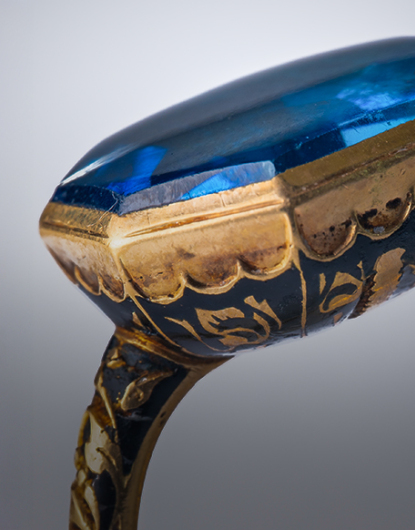
The ring is made of gold and decorated with black enamel coloured with lead-based mineral compounds. Set at its centre is a natural 18-carat sapphire — a coloured variety of corundum. The stone comes from Burma, and it was likely cut in France or Italy. The ring is said to be made around the mid-17th century.
Such artefacts hold a particular symbolic and historical significance, as they are associated with the liturgy, ecclesiastical office, personal piety and the display of their owners’ high status.
The Treasures from Łowicz exhibition is the first opportunity to see these extraordinary objects in one place and to look a tthem as a valuable testament to the history, art and ceremonial traditions of the Polish-Lithuanian Commonwealth.
The ring is made of gold and decorated with black enamel coloured with lead-based mineral compounds. Set at its centre is a natural 18-carat sapphire — a coloured variety of corundum. The stone comes from Burma, and it was likely cut in France or Italy. The ring is said to be made around the mid-17th century.
Such artefacts hold a particular symbolic and historical significance, as they are associated with the liturgy, ecclesiastical office, personal piety and the display of their owners’ high status.
The Treasures from Łowicz exhibition is the first opportunity to see these extraordinary objects in one place and to look a tthem as a valuable testament to the history, art and ceremonial traditions of the Polish-Lithuanian Commonwealth.